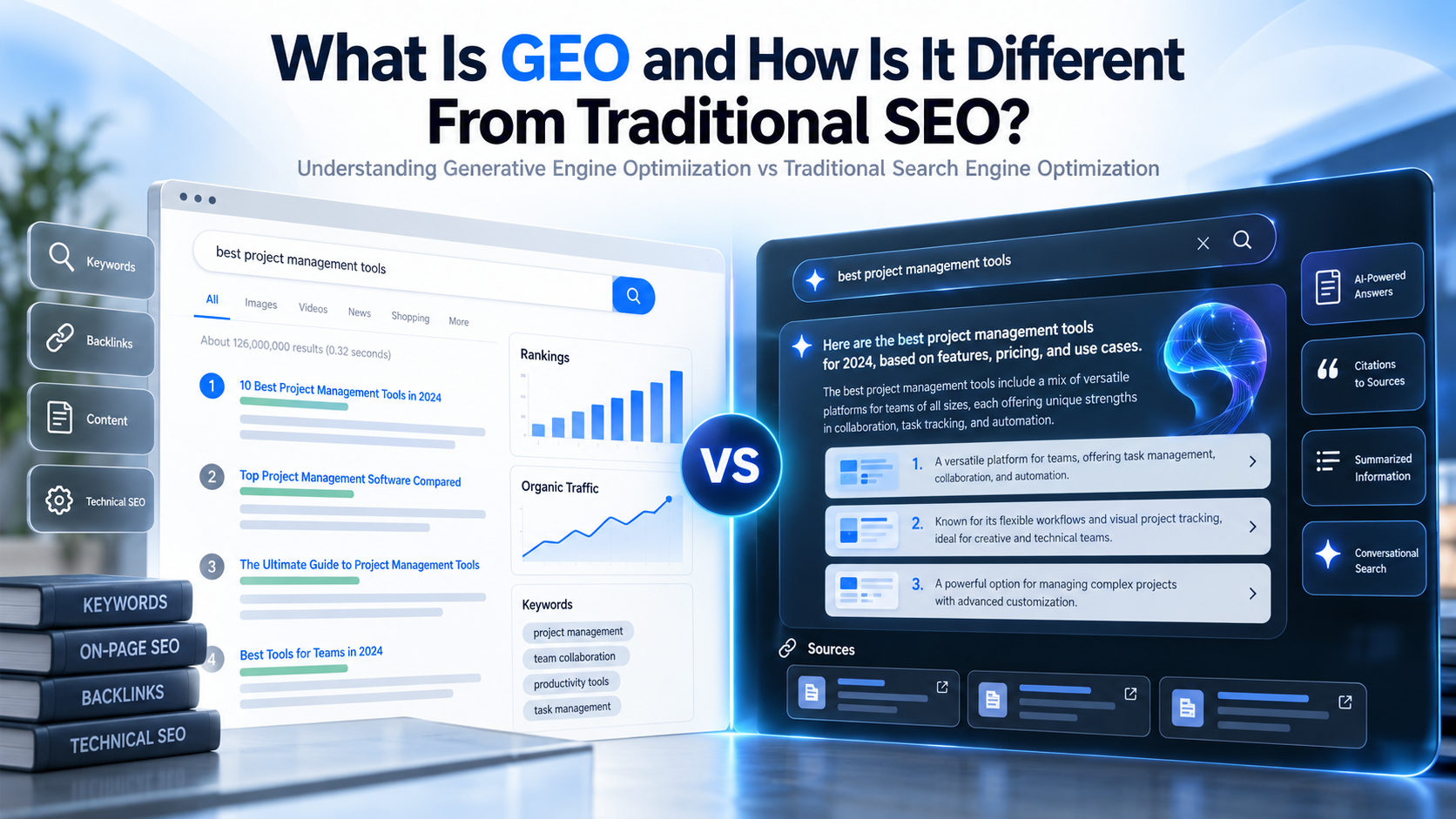
Search is changing.
For years, businesses focused mainly on SEO — Search Engine Optimization — to rank higher in Google and attract website visitors.
That is still important.
But people are now also finding information through AI-powered search experiences such as Google AI Overviews, ChatGPT, Gemini, Perplexity, and other generative AI platforms.
When web search or retrieval is enabled, these systems can create direct answers using information from multiple sources. Not every AI response searches the web or cites websites.
This change has introduced a newer term:
GEO — Generative Engine Optimization.
GEO focuses on making your content easier for AI systems to understand, trust, reference, and potentially include in generated answers.
However, GEO does not replace SEO. It builds on many of the same fundamentals.
Table of contents13 sections
What Is GEO?
Generative Engine Optimization (GEO) is the practice of improving your content and online presence so that generative AI systems can understand, retrieve, reference, mention, or cite your information when answering user questions.
Traditional search engines typically present users with links.
Generative engines may instead produce an answer such as:
“Here are five recommended tools for small businesses…”
and then reference several websites or brands as supporting sources.
The goal of GEO is to increase the likelihood that your website, brand, product, or expertise becomes one of those sources. The term appears in the original GEO research paper; its experimental findings are not a guarantee for every current AI platform.
What Is Traditional SEO?
Traditional SEO is the process of optimizing a website so that it can rank higher in search engine results pages.
For example, someone searches:
best AI tools for small businesses
Traditional SEO tries to get your article to appear near the top of Google results.
SEO normally includes areas such as:
- Keyword research
- On-page optimization
- Technical SEO
- Internal linking
- Backlinks
- Website speed
- Mobile usability
- Content quality
- Title tags
- Meta descriptions
- Structured data
The main objective is usually:
Higher rankings → more clicks → more organic traffic
GEO vs Traditional SEO
The main difference is where visibility happens.
| Traditional SEO | GEO |
|---|---|
| Focuses on search engine rankings | Focuses on AI-generated answers |
| Targets Google/Bing results | Targets AI search and answer systems |
| Measures rankings and clicks | Measures mentions, citations and visibility |
| Optimizes pages for search queries | Optimizes information for retrieval and synthesis |
| Goal is often website traffic | Goal may include brand visibility without a click |
| Strong backlinks help authority | Broader brand/entity authority can matter |
| Keywords remain important | Context and clear answers become especially important |
With SEO, you may ask:
“Does my page rank in the top 10?”
With GEO, you may ask:
“When someone asks ChatGPT or Google AI about this topic, does my brand or content appear in the answer?”
Does GEO Replace SEO?
No.
This is one of the most important things to understand.
For Google’s AI Overviews and AI Mode, established SEO fundamentals remain relevant. Other AI platforms have their own retrieval and eligibility systems.
A better strategy is:
SEO + GEO
SEO helps search engines discover and understand your website.
GEO describes efforts to make that information easier for generative systems to interpret and reuse. Google’s AI features guidance says that no additional special optimization is required for its AI search features.
What Is AI SEO?
AI SEO has no single, universally agreed meaning. In this article, it means improving visibility in AI-powered search. The term is also used for applying AI tools to ordinary SEO tasks, such as research and content analysis.
It can include:
- Google AI Overviews
- Google AI Mode
- ChatGPT search
- Perplexity
- Gemini
- Bing Copilot
- Other AI answer engines
In this sense:
AI search optimization = visibility across AI-powered search experiences
GEO = a term for optimization focused on generative AI answers
These are working definitions, not an official hierarchy or a separate set of platform ranking rules. The terminology is still evolving.
You may also see:
AEO — Answer Engine Optimization
This focuses on making content easy for systems to use when answering direct questions.
LLMO — Large Language Model Optimization
This focuses on visibility within LLM-based systems.
GEO — Generative Engine Optimization
This focuses on generative search engines and AI-generated responses.
In practice, these approaches overlap heavily.
How GEO Works
Generative search systems do not necessarily treat a webpage as one large document.
When a system retrieves web content, it may identify useful passages, facts, definitions, examples, tables, or data points and combine information from multiple sources when generating an answer. Retrieval methods differ between products.
That means content should be written so that individual sections make sense clearly on their own.
For example, instead of writing:
“As mentioned above, this is important because of several factors.”
write:
“Generative Engine Optimization helps AI systems understand and reference website content by providing clear, authoritative, and well-structured information.”
The second version is easier to understand even without additional context.
How to Optimize Content for GEO
There is no single trick that guarantees AI visibility.
But there are several practical things businesses and publishers can do.
1. Answer Questions Clearly
Give direct answers early.
If your heading is:
What is GEO?
the first paragraph below it should actually define GEO.
Avoid making users read five paragraphs before getting the answer.
2. Use Clear Headings
Structure content with descriptive H2 and H3 headings.
For example:
- What Is GEO?
- GEO vs SEO
- How Does GEO Work?
- How to Optimize for GEO
- Is GEO Replacing SEO?
This makes information easier for both people and machines to navigate.
3. Create Original, Useful Content
Do not simply rewrite what already exists online.
Include things such as:
- Original examples
- Real experience
- Case studies
- Data
- Comparisons
- Screenshots
- Opinions based on expertise
4. Build Topical Authority
Instead of writing one isolated article about a topic, create multiple related articles.
For example:
GEO
├── What Is GEO?
├── GEO vs SEO
├── How to Optimize for AI Search
├── AI SEO Checklist
├── ChatGPT Search Optimization
├── Google AI Overview Optimization
└── How to Track AI Visibility
Then connect them using internal links.
5. Make Facts Easy to Identify
Useful information should not be buried.
Use:
- Short explanatory paragraphs
- Lists
- Comparison tables
- Definitions
- Statistics
- Examples
For example:
Traditional SEO: Optimizes for rankings and clicks.
GEO: Optimizes for mentions and citations inside AI-generated answers.
6. Demonstrate Expertise and Trust
Clearly show who created the content.
Articles should include:
- Author name
- Author bio
- Relevant expertise
- Published date
- Updated date
- Sources where appropriate
7. Use Reliable Sources
When stating facts, statistics, pricing, technical requirements, or industry changes, reference reliable sources.
Good sources include:
- Official documentation
- Original research
- Government websites
- Product documentation
- Established industry publications
8. Keep Technical SEO Strong
GEO does not mean technical SEO becomes irrelevant.
Your website still needs to be:
- Crawlable
- Indexable
- Fast
- Mobile friendly
- Secure
- Properly linked internally
9. Use Structured Data Correctly
Structured data can help search engines better understand things such as:
- Articles
- Authors
- Products
- Organizations
- Dates
For blog content, Article or BlogPosting structured data can help clarify the article title, author, images, and publication information. See Google’s Article structured data documentation.
Structured data should match what is actually visible on the page.
It should not be treated as a shortcut for GEO. Google does not require special AI schema or new AI text files for inclusion in AI Overviews or AI Mode.
How Success Is Measured
Traditional SEO commonly tracks:
- Rankings
- Organic traffic
- Click-through rate
- Impressions
- Conversions
GEO introduces additional questions:
- Is your brand mentioned in AI responses?
- Is your website cited?
- Which prompts trigger your brand?
- How often are competitors mentioned instead?
- What topics are associated with your brand?
- Does AI-generated visibility lead to traffic or conversions?
This makes GEO measurement more complex than traditional SEO.
Example: SEO vs GEO
Imagine you publish:
10 Best AI Tools for Small Businesses in 2026
Traditional SEO Goal
Rank highly when someone searches:
best AI tools for small businesses
The user sees your result and clicks your website.
GEO Goal
Someone asks:
What are the best AI tools for a small business?
An AI system generates an answer and potentially uses, mentions, or cites information from your article.
Ideally, your SpikTop article benefits from both.
That is why the strongest long-term strategy is not:
SEO or GEO
It is:
SEO + GEO + helpful content
Should Small Businesses Care About GEO?
Yes, especially businesses that depend on online discovery.
AI search is creating additional places where customers may discover:
- Brands
- Products
- Services
- Experts
- Reviews
- Recommendations
A business that only monitors traditional Google rankings may eventually miss part of its overall search visibility.
However, GEO should not become an excuse to chase every new AI trend.
The fundamentals remain similar:
Create useful content, establish authority, make information clear, and ensure your website is technically accessible.
Final Thoughts
GEO is not a replacement for SEO.
It is an expansion of search optimization for a world where users increasingly receive answers directly from AI systems.
Traditional SEO focuses heavily on:
Rankings → clicks → website traffic
GEO adds another goal:
Authority → retrieval → mentions → citations → AI visibility
Businesses and publishers should therefore continue investing in solid SEO while adapting their content for AI-powered discovery.
The websites most likely to benefit are not necessarily those trying to “hack” AI systems.
They are the websites publishing clear, useful, credible, and original information that both humans and search systems can understand.
Frequently Asked Questions
What does GEO stand for?
GEO stands for Generative Engine Optimization. It refers to optimizing content for visibility within generative AI search and answer systems.
Is GEO the same as SEO?
No. SEO mainly focuses on rankings in traditional search results, while GEO focuses on visibility, mentions, and citations within AI-generated answers.
Is AI SEO the same as GEO?
The terms overlap, but their meanings vary. Here, GEO focuses on generative AI answers, while AI SEO refers to AI-powered search visibility more broadly. Elsewhere, AI SEO can instead mean using AI tools to perform SEO work.
Is GEO replacing SEO?
No. Useful content, crawlability, internal linking, and good website structure remain relevant. In particular, Google says its existing SEO guidance applies to AI Overviews and AI Mode.
Can GEO guarantee that ChatGPT will cite my website?
No. There is no guaranteed method to make an AI system cite a specific website. GEO is about improving the quality, accessibility, clarity, and authority of your information so that it is more suitable for retrieval and reference.
Sources
Primary references
- GEO: Generative Engine Optimization — original research paper
- Google Search Central — AI features and your website
- Google Search Central — Succeeding in AI search
- Google Search Central — Article structured data
Further industry reading
These supplied industry articles offer additional perspectives; their terminology should not be treated as official platform requirements.
Verification limitations
Primary references checked on 20 October 2026. This article is general guidance, not a test of a specific website or AI model. AI answers, citations, and product behavior can change, and no inclusion or traffic outcome is guaranteed. Google's eligibility guidance should not be assumed to apply identically to other AI platforms.